Simply Speech: phonological processes

Showing posts with label phonological processes. Show all posts

In My APPinion: Phono Learning Center

Tuesday, July 9, 2013
Appy Tuesday ya'll! Today I would like to share a new app by Smarty Ears called Phono Learning Center! This app  designed to be used with those individuals that are highly unintelligible. This app is based on the cycles approach, which was developed by Barbara Hodson. I don't know any other app that uses the cycles approach (way to go Smarty Ears!) Personally, I am a fan of the cycls approach. I may not follow it to the T, but I do use the cycle approach in most of my therapy sessions. 
Smarty Ears did provide me with a copy of Phono Learning Center, but the opinions in this review are mine.
When you start up the app, you are prompted to add or select player(s)... yes you can use this app with a group! When you add a new player, you are able to set individual setting based on the student's goals and needs. The screen shot below shows the options when adding a new student into the app. 
The first activity that the student is prompted with is an auditory bombardment activity. The students get to pop balloons with their finger and hear a target word as they pop each one. 
After that activity is completed, the student is prompted to choose from 4 different activities:
Balloon
Matching
Basket Paper
Puzzle
The photo above is of the balloon activity. Students drag target words into the balloon to help blow the balloon up. After it is filled, the balloon flies away!
The matching game is very similar to concentration or memory. There is a card face up at the bottom of the screen. The student has to find the match. 
Basket Paper is my personal favorite! The student is provided with a word to imitate on a piece of paper. After they produce the word, they tap the paper and it becomes a paper ball. The student then gets to shoot the paper ball into the basket!
The final activity is the puzzle. The student is provided with a puzzle piece with a target word. The student is to produce the target word then drag the puzzle piece to the puzzle. In addition to providing lots of opportunities for speech productions, this activity also lets you work on wh-questions and prediction goals. 

This app also keeps data in the Report Card center which can be referred to at the end of the session or later as needed. This app has been pretty popular with my younger students. I think that the variety of activities is what keeps their attention. I love the fact that this app provides so many opportunities for speech production and data collection. However, my favorite features of this app is that it includes homework worksheets! This would be great to email to parents after you complete a session! The only thing I would suggest for this app to add is the opportunity for students to record their productions. The recording option in apps not only is fun for the students but also helps them become aware of their errors. Overall, this is a great app and is used frequently in my therapy sessions!


Cluster Reduction Rodeo!

Friday, June 28, 2013
During Better Hearing and Speech Month, I dedicated an entire week to phonological processes. On one of my posts, I asked the question, "Which phonological process do you encounter the most?" I had an overwhelming response from fellow readers stating that cluster reduction is by far the most popular process among their students and clients. With that information in mind, I created Cluster Reduction Rodeo!
This activity is designed to be used with students that demonstrate the phonological process of cluster reduction. Cluster reduction is defined as the simplification of a cluster by deleting one of it’s sounds.


For example, the word school may be produced, “kool”


This is a 20 page activity that includes:
A game board. Use this game board with the cluster cards. Have students practice a target(s) from the cards then move across the board.
106 cluster target cards for the S, R, L sounds. 
Bonus game cards!
There is also a page of blank cards that you can use however necessary for your students' individual needs. 
Here is what some fellow SLPs that have downloaded this activity have said about it:
Quick and easy activity with cute Rodeo graphics. I like that she included some activities with medial /s/ blends!- Speech2u

This will be great to work on clusters! Thanks!
-Speech Universe

Simple and easy to use activity with adorable visuals that targets S, R, L clusters at word level.
-Tatyana Elleseff

Super cute graphics and theme! Definitely will get a lot of use out of this packet!
-Home Sweet Speech Room

Always need more s blend work! Thanks!
-Speech Room News

Great word choice and theme!
-Ms Jocelyn Speech


Final Consonant Deletion

Friday, May 10, 2013
Happy Friday and Day #5 of Phonological Process Week! Another phonological process that I see very often is final consonant deletion.
 Quick review, 
Final Consonant Deletion 
is when the last sound in a word is left off. 
For example, the word seed is produced "see."
This seems to be very common with little ones in conversational speech. They often drop sounds at the end of their words which makes their speech very hard to understand. 
I created this 14 page activity for my kiddos that demonstrate final consonant deletion. This pack includes a total of 78 cards (39 minimal pairs) that you can use as flashcards or practice in a game. There are images to go along with the word on the cards so the little ones can use this activity easily. Below are some examples from the packet. 

This activity is for sale in my TpT store for $2.00 or you can try to win a copy below!
a Rafflecopter giveaway


Multisyllabic Circus

Thursday, May 9, 2013
 Welcome to Day #4 of Phonological Process Week! I hope you all have found this week helpful with a little more information about phonological processes and some activities to help you help your kiddos! I have had multiple articulation students have difficulty producing multisyllabic words. I created this activity just for them! 
Multisyllabic Circus is an 18 page sorting activity that helps students that have difficulty with producing multisyllabic words and maybe even difficulty identifying the number of syllables in words. This activity would be helpful to classroom teachers working on identifying the number of syllables in words with their students. I love using this activity as a speech center. It can just as easily be used as a whole group activity as it can be for independent work. 
Here is how it works: 
Pages 6-17 are word cards that either have a 2, 3, or 4 syllable word and picture 
(the pictures can help the younger non-readers complete this activity independently.) 
Print, cut, and laminate the word/picture cards. 
Have the student choose a card and decide which circus tent the word belongs in.
Also included in the packet is 3 sorting mats for the students to place the word/picture cards
2 Syllable Circus Tent
3 Syllable Circus Tent
4 Syllable Tent
I also included these bonus cards for when the game is played with a group, who doesn't love extra turns?

This is one of my favorite actives to use in therapy. The circus theme is always a hit!


In My APPinion: Phonological Processes by VSC, Inc.

Wednesday, May 8, 2013
What better time to review the Phonological Processes app than during Phonological Processes Week?!  Over the last few days I have shown you some printable materials you can use to help your kiddos who have phonological disorders. Well, "there's an app for that" too! The Phonological Processes app was created by Virtual Speech Center for students ages 4 and up who exhibit phonological disorders and/or delays. This is a research based app that uses minimal pairs. 

To get started, first enter your student(s) names into the app. Then you are able to select prompts individually for each student playing. This app addresses the following phonological processes:
Affrication
Deaffrication
Cluster Reduction (L, R, S, mixed)
Final Consonant Deletion
Fronting
Gliding (L, R, mixed)
Prevocalic Voicing
Stopping (Fricatives, Affricates, Mixed)

You also have the option of how the prompts are presented:
Auditory Bombardment with Minimal Pairs
Auditory Discrimination with Minimal Pairs
Minimal Pair Production
Single Word Production
Once you have the settings complete, you have two playing options:
Flashcards or Game Board
If you choose flashcards, the students are presented with prompts like the ones below. 
In this picture, the student is prompted to say the two words: swing and wing. Each flashcard also allows the student to record their responses (I always love this option in an app!)

If you choose the Game Board option, you get to have some fun in the jungle!! My students are always asking if we are playing the jungle game each time I pull out my iPad! The Game board option presents the flashcards to the students as well but also lets them move around the board activating jungle animals and sounds! This game is easily completed in one therapy session (maybe even twice!)

PS- this app is great for data collection and sharing information with parents and teachers!
You can purchase this app in the iTunes store for $16.99 or try to win a copy below!


Superhero Stopping!

Tuesday, May 7, 2013
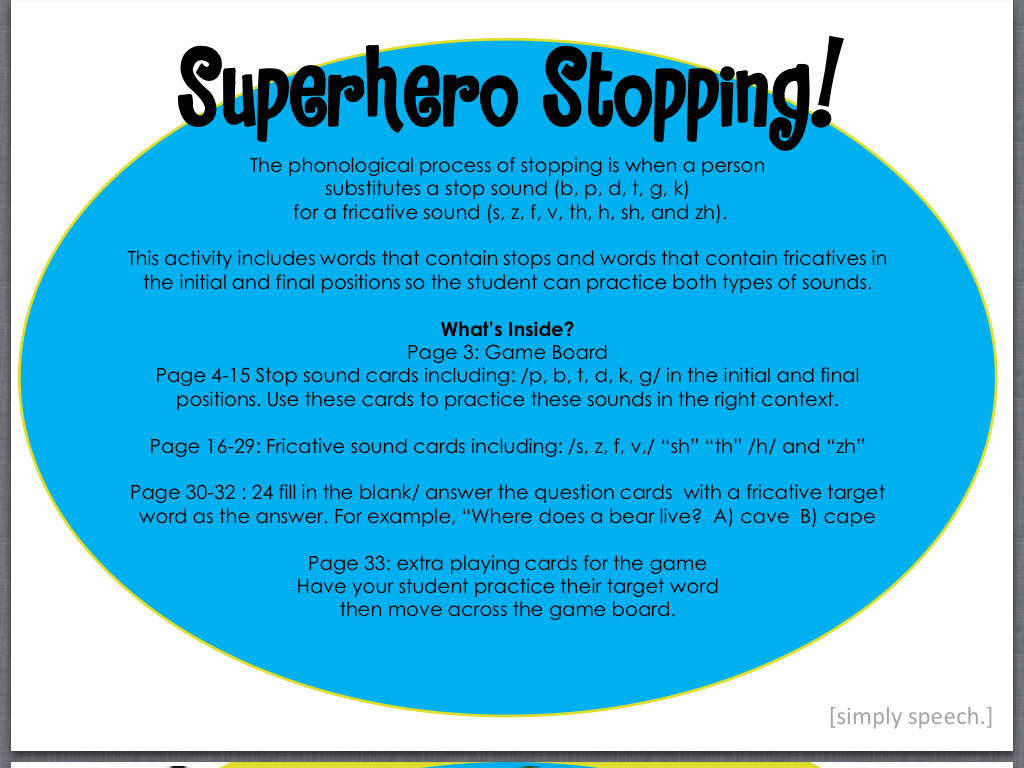
Happy Tuesday!! That means that today is day #2 of Phonological Process Week. Another common phonological process that your child or students may exhibit is called stopping. Stopping  is when a person substitutes a stop sound for a fricative sound. Let's stop and review for a minute....
Stop Sounds:
/b, p, d, t, g, k/
Fricative Sounds:
/s, z, f, v, th, h, sh, zh/
So for example, if a child demonstrated stopping, he or should may say "box" for fox or "tire" for fire. 
Sound familiar?
To work on correcting this phonological process, I created Superhero Stopping! This is a 33 page activity that targets both stops and fricatives. I chose to include both sets of sounds so that the student can practice the stops in the right context. 
The screenshot below is of the Superhero Stopping game board. Move around the board as your child/student correctly practices a target word from the deck. 


This is my favorite part of the activity! I also included 24 multiple choice question cards. All cards have a fricative target as the answer so the student has even more practice with these words. 
Where does a bear live? 
a) cave  
b) cape
The last page includes bonus cards to use in the game just for fun :)
You can purchase this activity in my Teachers Pay Teachers store for $3.00 here
or try to win a copy below! 
PS- don't forget there is a "Speech"er appreciation sale going on May 7-8!


Fronting: A Minimal Pairs Pack

Monday, May 6, 2013
One of the most common phonological processes disorders is Velar Fronting.  For those readers that are not SLP's (and those of us that are and could use a refresher!) fronting is just like it sounds: the process of producing sounds that should be produced in the back of the mouth in the front... makes sense, right? For example, a child may produce the word cup as "tup" or gate as "date." One trick that I like  love using with my students is having them lay on the floor while we practice these targets.
I created a 22 page activity that targets velar fronting. It is made up of minimal pair targets so the child can visually see and hear the difference in the two words. If the child requests tea but says key, you can show them the difference using the minimal pair. 

To use this activity, print out the cards on card stock , cut, and laminate. You can use them as flashcards or use the game board and have the students practice the target(s) before they take a turn in the game. 


Using minimal pairs is very helpful for the child to really understand the difference in what they are saying and what they mean. Most students don't realize that they are saying the word wrong. This is when pulling out your iPad and recording their productions is helpful. 
You can download a copy of Fronting: A Minimal Pairs Pack for $2.50 here or try to win a copy below!


Welcome to Phonological Processes Week!

Welcome to the first day of Phonological Processes Week here at Simply Speech! Learning about the different types of phonological processes while in school was enough to make my head spin! After all there are SO many different phonological processes kids can demonstrate. Phonological processes are patterns of sound errors that typically developing children use to simplify speech. It's often hard to differentiate the difference between an articulation disorder and a phonological disorder. I found this great chart from the Mommy Speech Therapy blog that explains phonological process disorders with definitions and examples. No need to reinvent the wheel, so I am going to share it here:
Check out Heidi's post and download the chart here!

Stay tuned for more information on specific phonological process disorders and giveaways of products and reviews made to target these disorders!


Powered by Blogger.